
Cultural Assessments vs. Employee Surveys: Which Is Better For Your Mission-Driven Organization?
You're sitting in another leadership meeting, staring at employee survey results that look... fine. Engagement scores are decent. People seem satisfied. But something feels off. Your nonprofit's mission to "transform communities through education" isn't translating into the passionate, purpose-driven culture you envisioned. Your team goes through the motions, but where's the fire?
If this scenario sounds familiar, you're not alone. Many mission-driven organizations: from educational institutions to nonprofits to values-based enterprises: find themselves caught between two measurement approaches: traditional employee surveys and cultural assessments. The question isn't just which one to use, but which one actually tells you what you need to know.
Let's break down the real differences and help you make a strategic choice that aligns with your organization's deeper purpose.
What Employee Surveys Actually Measure (And What They Miss)
Employee engagement surveys are the workplace equivalent of asking "How are you feeling today?" They're designed to capture immediate satisfaction levels, motivation, and whether people feel supported in their roles. Think job satisfaction, manager relationships, workload balance, and career development opportunities.
The strengths are obvious: These surveys excel at pinpointing operational gaps that affect day-to-day performance. They'll tell you if people need better communication from leadership, more professional development, or clearer role expectations. For mission-driven organizations, they can reveal whether your values-based initiatives are landing well with staff.
But here's what they often miss: Employee surveys measure individual experience, not collective culture. You could have highly engaged employees who are still operating in ways that completely contradict your organizational mission. A satisfied workforce doesn't necessarily mean a mission-aligned workforce.
Consider this: Your education nonprofit might have teachers who love their jobs and feel supported by management, but they're still operating in silos instead of collaborating to serve students holistically. The survey shows high engagement, but your mission of "integrated student support" isn't actually happening.
What Cultural Assessments Reveal About Your Organization's DNA
Cultural assessments dig deeper. Instead of asking "Are you happy here?", they ask "What do our values actually look like in practice?" They examine the shared beliefs, behaviors, and unspoken rules that govern how work really gets done.
Cultural assessments measure organizational alignment: Do your stated values match your lived experience? When conflict arises, how do people actually handle it? What behaviors get rewarded or ignored? How do decisions really get made, regardless of what the org chart says?
This strategic lens becomes crucial for mission-driven organizations because your culture either supports or undermines your mission: there's no neutral ground. You can't transform communities, advance social justice, or drive educational equity if your internal culture doesn't embody those same principles.
The power of cultural assessments lies in their ability to reveal systemic patterns. They'll show you if your "collaborative decision-making" value is actually practiced, or if power dynamics and communication breakdowns are sabotaging your team's ability to serve your mission effectively.
The Side-by-Side Reality Check
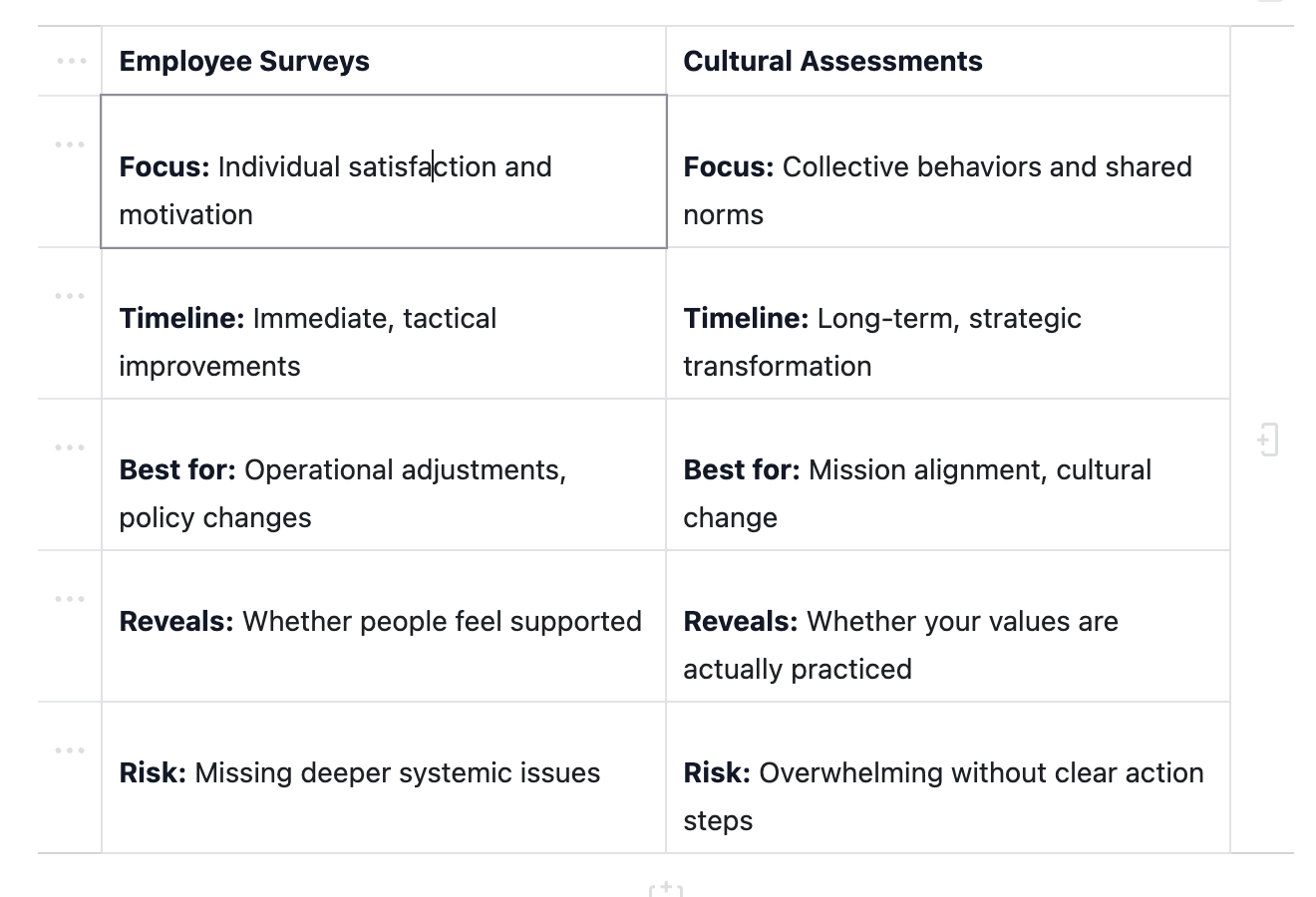
Here's a scenario that illustrates the difference: Your social justice nonprofit shows high engagement scores: people believe in the work and feel valued. But a cultural assessment reveals that white staff members consistently dominate strategic conversations while staff of color feel unheard in key decisions. Your mission of "equity and justice" is being undermined by cultural patterns that contradict everything you stand for.
The employee survey captured satisfaction, but the cultural assessment exposed a mission-critical misalignment.
Why Mission-Driven Organizations Need to Think Differently
For organizations centered on a clear mission or values proposition, cultural assessments become essential first steps, not nice-to-have add-ons. Here's why:
Your mission is your competitive advantage. Unlike traditional businesses that compete primarily on products or services, mission-driven organizations succeed when their purpose genuinely permeates everything they do. Cultural assessments reveal whether that's actually happening or just wishful thinking on paper.
Conflict resolution and organizational alignment go hand in hand. When your culture supports healthy dialogue and collaborative problem-solving, teams can navigate the complex challenges that come with mission-driven work. Cultural assessments identify where communication breakdowns are undermining your ability to serve your constituents effectively.
Mission-driven work requires relational leadership. Your success depends on people working together toward shared goals, not just individual performance. Cultural assessments reveal the quality of relationships, trust levels, and whether your leadership approach actually builds the collaborative capacity your mission requires.
The Strategic Approach: When to Use Each Tool
Start with cultural assessment if:
You've recently clarified or updated your mission
You're integrating teams or departments
Engagement scores look fine but something still feels "off"
You're experiencing recurring conflicts or communication breakdowns
Leadership transitions have changed organizational dynamics
You want to ensure your values are authentically embedded, not just posted on walls
Use employee surveys to:
Track whether mission-aligned staff feel supported in their roles
Identify operational barriers preventing people from living out your values
Monitor satisfaction levels around mission-related initiatives
Gather specific feedback on programs, policies, and management practices
Practical Recommendations for Getting Started
If you're choosing just one approach (budget or time constraints), go with cultural assessment for mission-driven organizations. Here's why: you can have satisfied employees who aren't aligned with your mission, but you can't have authentic mission alignment without eventually improving employee satisfaction.
For the integrated approach, consider this sequence:
Year 1: Comprehensive cultural assessment to establish baseline mission alignment
Year 1 (6 months later): Targeted employee survey focused on areas identified in cultural assessment
Year 2: Follow-up cultural pulse survey to measure progress on key alignment issues
Year 2: Annual engagement survey to ensure people feel supported in the cultural changes
Making it actionable: The best assessments: whether cultural or engagement: include built-in action planning. Look for tools that don't just generate reports but facilitate team building workshops and guided conversations about the results. Your assessment should lead to facilitated dialogues that strengthen relationships and improve organizational alignment.
Turning Insights Into Mission-Aligned Action
Remember, neither tool is valuable unless it leads to meaningful change. The goal isn't perfect scores: it's authentic alignment between what you say you value and how you actually operate.
For mission-driven organizations, this means:
Using assessment results to facilitate honest conversations about gaps between values and practice
Investing in conflict resolution skills that help teams navigate mission-related tensions constructively
Creating regular opportunities for staff to connect their daily work to larger organizational purpose
Building leadership capabilities that support both mission clarity and team collaboration
Your choice between cultural assessments and employee surveys isn't just about measurement: it's about whether you're willing to dig deep enough to ensure your organization's culture actually supports the change you're trying to create in the world.
The question isn't whether your people are happy. The question is whether your organizational culture is genuinely equipped to fulfill your mission. Cultural assessments help you answer that question with the strategic depth your important work deserves.
Ready to explore which approach is right for your organization? Whether you're looking to strengthen organizational alignment, improve team dynamics, or ensure your culture supports your mission, Lowe Insights Consulting offers both comprehensive cultural assessments and strategic guidance for mission-driven leaders. Schedule a 1:1 consultation to discuss your organization's specific needs and develop a measurement strategy that actually drives meaningful change.
